Artificial intelligence has traditionally relied on powerful cloud infrastructure. Whether you're using ChatGPT, Claude, Gemini, or an AI-powered business application, much of the processing happens in remote data centers operated by technology companies.
But what if you could run powerful artificial intelligence models directly from your desk, without sending every request to an external server?
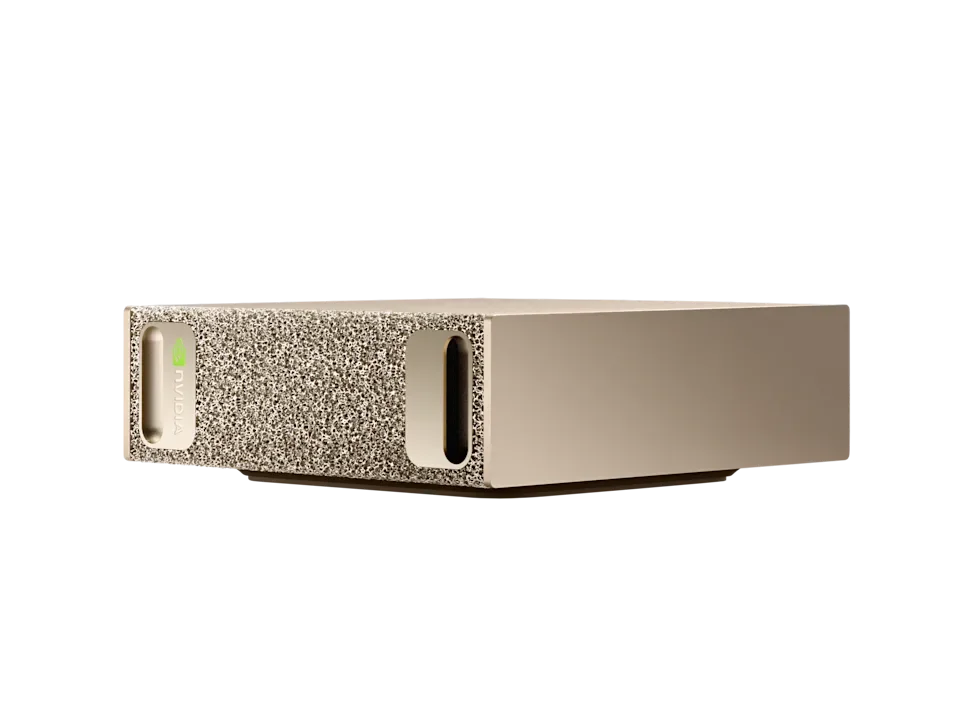
That is the idea behind the NVIDIA DGX Spark, a compact personal AI supercomputer designed for developers, researchers, and businesses that want to build and run advanced AI applications locally.
With up to 128 GB of unified memory, NVIDIA's Grace Blackwell architecture, and support for large language models containing billions of parameters, DGX Spark offers capabilities previously associated with much larger computing systems.
However, an important question remains: Can a machine sitting on your desk genuinely replace cloud-based AI services?
The answer is more complicated than a simple yes or no.
1. What Is NVIDIA DGX Spark?
NVIDIA DGX Spark is a compact AI computing system built specifically for artificial intelligence development, experimentation, inference, and model fine-tuning.
Unlike an ordinary desktop computer, DGX Spark is designed around the demanding memory and computational requirements of modern AI models.
At its core is the NVIDIA GB10 Grace Blackwell Superchip, which combines an ARM-based CPU with NVIDIA Blackwell GPU technology.
One of its most important features is unified memory, allowing the CPU and GPU to access a shared pool of system memory.
This is particularly useful when running large language models that would otherwise exceed the dedicated GPU memory available in many consumer computers.
NVIDIA DGX Spark Specifications
ComponentSpecificationProcessorNVIDIA GB10 Grace Blackwell SuperchipCPU20-core ARM architectureGPUNVIDIA Blackwell architectureAI performanceUp to 1 PFLOP at FP4 precision with sparsityMemoryUp to 128 GB unified LPDDR5xMemory bandwidth273 GB/s on the 128 GB modelStorageNVMe SSD, configuration-dependentNetworking10 GbE and high-speed ConnectX networkingOperating systemNVIDIA DGX OS, Linux-basedAI model inferenceUp to 200 billion parameters, subject to configurationModel fine-tuningUp to 70 billion parameters in supported workflows
Source: NVIDIA DGX Spark official specifications and technical documentation.
These specifications are impressive for a compact desktop system. However, the advertised one-petaflop figure refers to specialized low-precision AI calculations under specific conditions.
It should not be confused with general computing performance or taken to mean DGX Spark is faster than every cloud GPU.
2. Understanding Local AI vs Cloud AI
Before comparing performance and cost, it is important to understand how the two approaches work.
Cloud-Based Artificial Intelligence
Cloud AI operates on remote infrastructure managed by providers such as OpenAI, Anthropic, Google, Microsoft, or cloud hosting companies.
When a user submits a request, the application communicates with a remote server, which processes the request and returns a response.
For example, when a developer integrates the OpenAI API into an application, the AI computation generally happens on OpenAI-managed infrastructure.
This approach offers several advantages, including access to powerful proprietary models, reduced infrastructure management, and the ability to scale without purchasing physical hardware.
However, cloud services may introduce recurring usage costs, network dependency, data governance concerns, and limitations imposed by the provider.
Local Artificial Intelligence
Local AI takes a different approach.
Instead of sending requests to a remote AI provider, the model runs on hardware owned or controlled by the developer or organization.
For example, a business could deploy an open-weight language model on DGX Spark and expose it through a private API.
Internal applications could then communicate directly with that local AI service.
The organization would have greater control over model selection, infrastructure, access permissions, and data processing.
However, local deployment also means taking responsibility for maintaining the hardware, securing the system, updating models, and ensuring sufficient computing capacity.
The important distinction is that cloud AI provides computing as a service, while local AI gives organizations more direct control over the computing environment.
3. Can DGX Spark Run Large Language Models?
One of DGX Spark's biggest advantages is its memory capacity.
Many modern AI models require substantial memory simply to load their parameters.
A model containing 70 billion parameters, for instance, requires approximately 140 GB for its weights alone when stored at 16-bit precision.
That exceeds the dedicated graphics memory available on most consumer GPUs.
However, reducing model precision through quantization can substantially lower memory requirements.
At approximately 4-bit precision, the raw weights of a 70-billion-parameter model require around 35 GB, excluding quantization overhead, runtime buffers, and other memory requirements.
This is where DGX Spark's unified memory becomes useful.
Its 128 GB configuration allows developers to experiment with larger models than would comfortably fit on many traditional desktop GPUs.
NVIDIA advertises support for inference on models with up to 200 billion parameters and fine-tuning of models with up to 70 billion parameters in supported configurations.
However, being able to load a model is not the same as being able to run it quickly.
Actual performance depends on factors such as model architecture, quantization, context length, inference software, and the number of simultaneous users.
A smaller, optimized model may deliver a better real-world experience than a much larger model running near the limits of available memory.
4. Running Local AI Models with Ollama
One practical way to start using local AI is through Ollama, a tool that simplifies downloading, managing, and running compatible language models.
Instead of building an inference system from scratch, developers can use Ollama to run supported models through a command-line interface or API.
For example, after installing a compatible version of Ollama, a developer can run:
ollama run llama3.2
This downloads and launches the selected model, allowing the user to interact with it directly.
Ollama also exposes an HTTP API, making it possible to integrate local models into custom software applications.
A typical development setup could involve:
NVIDIA DGX Spark for AI inference.
Ollama or another supported inference engine for model serving.
Python and FastAPI for backend services.
PostgreSQL and a vector database or vector extension for knowledge retrieval.
Next.js or Flutter for user-facing applications.
Docker for application deployment.
This architecture can support internal AI assistants, document-processing applications, coding tools, and business automation systems.
For more demanding workloads, developers may consider inference engines such as NVIDIA TensorRT-LLM, vLLM, or other compatible serving frameworks.
The choice depends on model compatibility, throughput requirements, available memory, and the application being developed.
5. Can DGX Spark Replace ChatGPT, Claude, or Gemini?
This is where expectations need to be realistic.
DGX Spark is hardware. ChatGPT, Claude, and Gemini are AI products and model ecosystems.
Owning powerful AI hardware does not automatically provide access to the proprietary models powering those services.
For example, purchasing DGX Spark does not mean you can download and run Anthropic's proprietary Claude models locally.
Instead, developers can deploy compatible open-weight models, including selected models from families such as Llama, Qwen, Mistral, and other supported systems.
These models can be highly capable, particularly for specialized applications.
However, performance and reliability vary significantly across models and tasks.
A local model may be suitable for summarizing documents, answering questions from an internal knowledge base, or assisting with programming.
For complex reasoning, specialized multimodal processing, or tasks requiring particular capabilities, a cloud-based frontier model may still offer better results.
The correct comparison is therefore not simply DGX Spark versus ChatGPT.
It is a particular locally deployed model running on DGX Spark versus a particular cloud model or service, measured against the requirements of an actual application.
6. Local AI vs Cloud AI: Which Is Better?
Both approaches offer meaningful advantages.
FactorNVIDIA DGX SparkCloud AI servicesInitial investmentHigh hardware purchase costUsually little or no hardware investmentOngoing costsElectricity, maintenance, operationsSubscriptions or usage-based chargesData controlGreater direct infrastructure controlDepends on provider and contractInternet dependencyCan operate offline after setupGenerally requires connectivityModel flexibilityCompatible locally deployable modelsProvider-supported modelsScalabilityLimited by local infrastructureOften more flexibleMaintenanceManaged by ownerPrimarily managed by providerPerformanceDepends on local hardware and modelDepends on service, model, and planAvailabilityOwner must manage reliabilityProvider-managed, subject to outagesBest suited forPrivate development and controlled workloadsScalable applications and managed AI access
Neither approach is automatically superior.
Cloud AI is often attractive when workloads fluctuate, teams need fast deployment, or organizations require access to leading proprietary models.
Local AI becomes especially interesting when organizations need more infrastructure control, predictable workloads, offline operation, or specific data-handling arrangements.
7. Is Running AI Locally Actually Cheaper?
Cost is one of the most frequently misunderstood aspects of local AI.
At first glance, purchasing hardware might seem expensive compared with paying for an API subscription.
However, recurring cloud costs can accumulate as usage grows.
As of November 2026, NVIDIA's US marketplace lists a 128 GB DGX Spark configuration at approximately $6,950, excluding any applicable local taxes, shipping, and import-related costs.
A basic ownership calculation illustrates the trade-off.
Suppose an organization purchases the machine for $6,950 and uses it over three years.
The hardware cost alone averages approximately $193 per month over 36 months.
That figure does not include electricity, networking, maintenance, potential repairs, staff time, or the cost of additional infrastructure required for reliability.
For comparison, a cloud AI application billed at $300 per month would cost $10,800 over three years, assuming usage and pricing remain unchanged.
But that does not mean DGX Spark is automatically cheaper.
The two options may deliver very different model quality, throughput, availability, and operational capabilities.
A meaningful comparison requires evaluating the total cost of ownership against the cost of delivering an equivalent workload in the cloud.
Organizations should consider:
1. Utilization: A machine used continuously can potentially offer better economics than expensive hardware sitting idle most of the day.
2. Model requirements: A locally deployable model may be cheaper to operate but might not perform as well as the cloud model it replaces.
3. Electricity and cooling: Although DGX Spark is relatively compact, it still consumes power and needs a suitable operating environment.
4. Engineering effort: Maintaining local AI infrastructure requires time, updates, monitoring, troubleshooting, and security management.
5. Reliability: A production service may require backups, failover systems, additional hardware, or cloud redundancy.
The cheapest AI infrastructure is not necessarily the one with the lowest hardware price or API bill. It is the one that meets the application's requirements at the lowest sustainable total cost.
8. Data Privacy: One of Local AI's Strongest Advantages
Data privacy is an important reason organizations explore on-premise artificial intelligence.
Consider a hospital using AI to help authorized staff analyze internal documents, a financial institution working with confidential business records, or a company processing sensitive contracts.
Sending such information to an external provider may create additional questions about data handling, contractual obligations, security, and compliance.
Running a model locally can reduce the need to transmit sensitive prompts and documents to third-party AI services.
However, local deployment does not automatically guarantee privacy or regulatory compliance.
Organizations must still implement encryption, access controls, authentication, logging policies, backup protection, security updates, and appropriate data retention practices.
In Kenya, organizations processing personal information must also consider their obligations under the Data Protection Act, 2019.
Local infrastructure can support a data protection strategy, but where information is processed is only one part of compliance.
Security ultimately depends on the entire system architecture and how responsibly the organization manages its data.
9. Where DGX Spark Makes the Most Sense
Not every organization needs a dedicated AI supercomputer.
However, there are several situations where DGX Spark can provide practical value.
Private Enterprise AI Assistants
A company could deploy an internal assistant that helps employees search policies, summarize documents, and answer questions using approved organizational information.
By combining a local language model with retrieval-augmented generation (RAG), the organization can build an AI system grounded in its internal knowledge base.
Software Development and Research
Developers can use local models to experiment with coding assistants, evaluate prompts, test AI integrations, and build new applications without paying an external provider for every model request.
This can be especially valuable during development workflows involving repeated testing.
Education and Training
Universities, research institutions, and technical training organizations can use local AI infrastructure for teaching machine learning, model evaluation, fine-tuning, and practical AI engineering.
Students can gain experience with model deployment rather than interacting exclusively with hosted chat interfaces.
Specialized Business Automation
Organizations can build AI systems for document classification, information extraction, internal reporting, customer service, and other repetitive processes.
A local deployment may be attractive when workloads are predictable and the chosen model reliably handles the tasks.
AI Research and Fine-Tuning
Researchers can experiment with supported large models, optimization methods, quantization, and fine-tuning techniques.
However, DGX Spark is not intended to replace large multi-GPU data centers for training frontier foundation models from scratch.
10. The Limitations Nobody Should Ignore
Despite its capabilities, DGX Spark has important limitations.
Memory capacity is not unlimited compute performance. Large models may fit into unified memory but still generate responses more slowly than expected.
Concurrency is limited. Serving one developer is very different from serving hundreds or thousands of simultaneous users.
Local models require evaluation. An open-weight model that performs well on one task may struggle with another.
Hardware can fail. Unlike a managed cloud platform, a single local machine creates an availability risk unless redundancy is introduced.
Infrastructure still needs expertise. Model deployment, networking, security, storage, observability, and updates remain the organization's responsibility.
Not every application benefits from local inference. Some projects are better served by inexpensive API calls or managed cloud infrastructure.
Recent research into DGX Spark inference performance also demonstrates that deployment choices matter.
A November 2026 study examining one- and two-device configurations found that connecting two systems could improve throughput, but performance gains varied depending on the parallelization strategy and workload.
This reinforces an important principle: real-world AI performance should be measured rather than assumed from hardware specifications.
11. Why a Hybrid AI Architecture May Be the Best Choice
For many businesses, the most practical solution is neither fully local nor fully cloud-based.
It is a hybrid architecture.
Under this approach, an organization runs selected AI workloads locally while maintaining access to cloud-based services when necessary.
For example, a software company could use DGX Spark for internal document retrieval, routine summarization, and development testing.
When a task requires a more capable proprietary model, greater inference capacity, or specialized cloud functionality, the system could route that request to an external provider.
A hybrid architecture offers several advantages:
Local processing for appropriate sensitive or predictable workloads.
Access to cloud-based models when additional capabilities are necessary.
Flexibility to distribute workloads based on cost and performance.
The ability to scale beyond the capacity of a single local device.
Reduced dependence on one infrastructure provider.
However, hybrid systems must be designed carefully.
Routing sensitive information to the cloud requires appropriate authorization and governance. Organizations should also monitor costs, model quality, latency, and reliability across both environments.
12. What Does Local AI Mean for African Technology Companies?
For software companies and technology startups in Africa, local AI infrastructure presents both opportunities and challenges.
One opportunity is the ability to develop solutions that can operate without constant dependence on international AI APIs.
A locally hosted model could support business applications, educational systems, internal knowledge platforms, and research environments.
This may be particularly relevant where connectivity, data residency requirements, or API costs create practical constraints.
However, the economics must be considered carefully.
In Kenya, imported hardware may involve significant procurement costs, while electricity reliability, technical support, and replacement parts can affect long-term operations.
For a small startup serving a limited number of users, cloud AI may remain substantially more economical.
For a research institution or software company running frequent, predictable AI workloads, dedicated local infrastructure may become more attractive.
The opportunity is not simply to own powerful hardware.
It is to use the available computing resources to develop useful, affordable, and reliable technology solutions.
13. Final Verdict: Can NVIDIA DGX Spark Replace Cloud AI?
Yes, NVIDIA DGX Spark can replace certain cloud AI workloads, but it cannot replace every cloud AI service.
For developers experimenting with open-weight models, businesses building private AI assistants, and researchers working with large models, DGX Spark provides a compelling local computing platform.
Its unified memory, NVIDIA software ecosystem, and compact design make advanced AI experimentation more accessible outside traditional data centers.
However, cloud AI retains significant advantages in scalability, managed availability, access to proprietary frontier models, and operational convenience.
The decision should depend on the application rather than the excitement surrounding the hardware.
Before investing in local AI infrastructure, organizations should ask:
Does the selected model meet our quality requirements? How frequently will it be used? What are our privacy obligations? How many users must it support? And what is the real cost of operating it reliably?
For most organizations, a carefully designed hybrid approach will offer the best balance of control, flexibility, and performance.
The Bigger Picture
The significance of NVIDIA DGX Spark extends beyond a single product.
It illustrates an important shift in artificial intelligence: increasingly capable models can now run on computing systems small enough to fit on a desk.
As AI models become more efficient and local computing hardware continues to evolve, developers will have more options for choosing where intelligence runs.
The future of artificial intelligence is unlikely to belong exclusively to the cloud or to local hardware.
It will belong to systems that intelligently combine both.
Written by Daniel Chacha, Software Developer and Founder of Chacha Technologies.
Chacha Technologies develops software solutions, AI-powered applications, and digital infrastructure for businesses and organizations.
References and Further Reading
NVIDIA — DGX Spark official product specifications: https://www.nvidia.com/en-us/products/workstations/dgx-spark/
NVIDIA — DGX Spark technical documentation: https://docs.nvidia.com/dgx/dgx-spark/
NVIDIA Developer — Build Local AI with NVIDIA GPUs: https://developer.nvidia.com/topics/ai/local-ai
NVIDIA Marketplace — DGX Spark pricing: https://marketplace.nvidia.com/en-us/enterprise/personal-ai-supercomputers/dgx-spark/
Ollama — Official documentation: https://docs.ollama.com/
Bhimani et al. — Benchmarking LLM Inference on Desktop-Scale NVIDIA Grace Blackwell Clusters, November 2026: https://arxiv.org/abs/2611.20289
Republic of Kenya — Data Protection Act, 2019.